
 All Posts
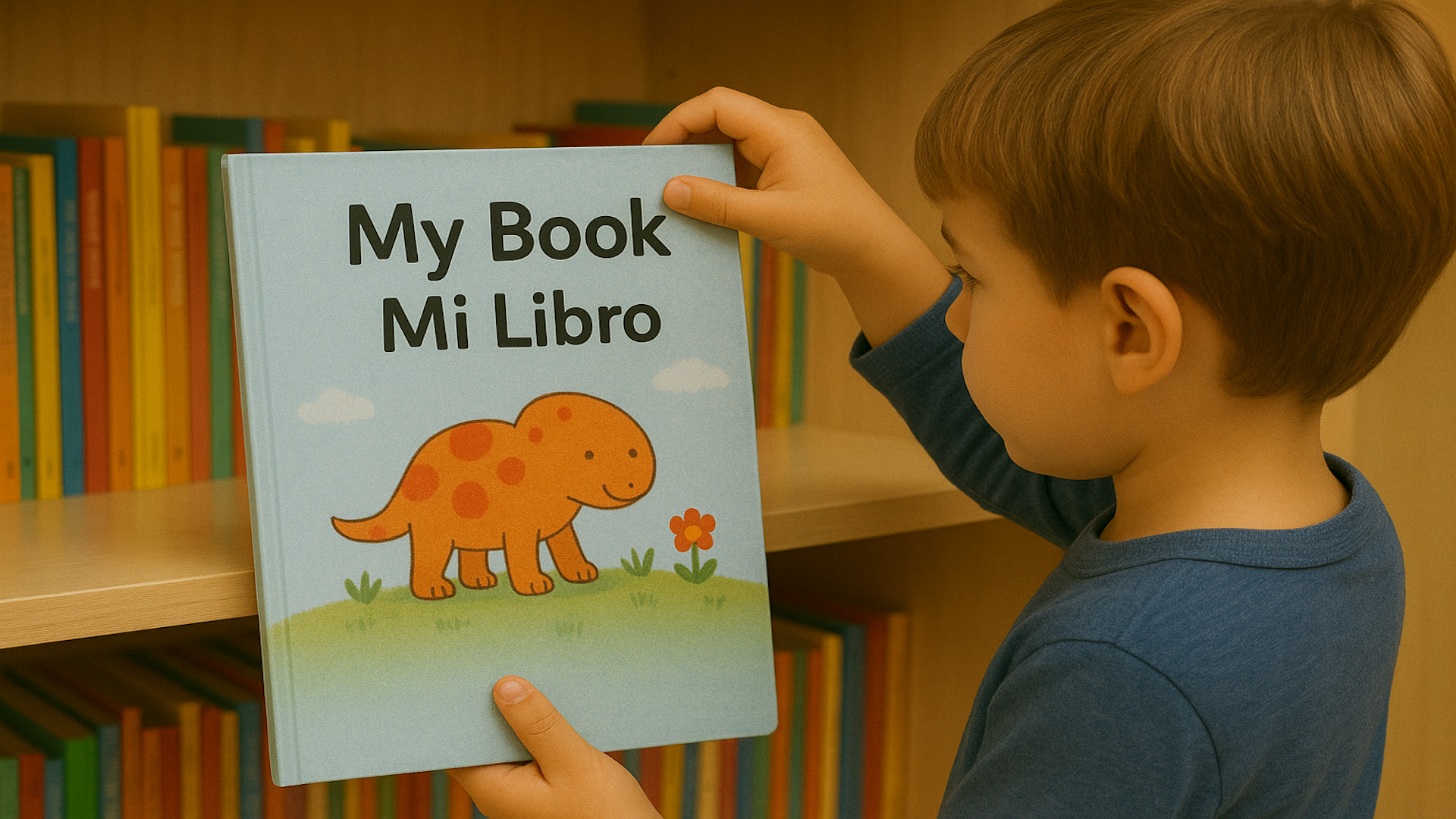
Many parents today are wondering the same thing: “Should I read children’s books to my child in Spanish or another language—or should I stick to English?”
This question comes from a place of love and intention. Parents want to give their children every advantage but often worry about confusing them, slowing down English development, or choosing the “wrong” approach.
The reality is far simpler—and far more exciting:
Reading children’s books in multiple languages is one of the most powerful literacy gifts you can give a child ages 3–8.
Research consistently shows that multilingual reading strengthens vocabulary, boosts cognitive development, accelerates English literacy skills, and deepens cultural awareness¹²³.
Below, we break down the science in parent-friendly language and show what reading in multiple languages actually does for children during the formative early reading years.
1. Reading in Any Language Builds Core Literacy Skills
Young children do not learn to read in isolated “language silos.” The brain builds literacy through broad skills—letter awareness, sound recognition, storytelling, vocabulary—that can be applied across languages.
This principle is known as cross-linguistic transfer³, and it means:
- If your child learns how stories work in Spanish, they understand story structure in English.
- If your child builds vocabulary in another language, it strengthens the mental networks they use to learn English words.
- If a child learns to decode in a phonetic language (like Spanish), those decoding skills help with English phonics.
Why this matters:
Parents often assume reading must be in English to “count” academically. But the brain doesn’t categorize literacy by language—it categorizes literacy by skill.
Parents often assume reading must be in English to “count” academically. But the brain doesn’t categorize literacy by language—it categorizes literacy by skill.
Example:
A child reads a picture book about animals in Mandarin. They learn concepts like categories, describing features, and sequencing. These cognitive skills support reading comprehension in English—even if the vocabulary is different.
The research is clear:
Reading in any language strengthens reading in every language.¹²³
Reading in any language strengthens reading in every language.¹²³
2. Children Who Are Exposed to Multiple Languages Early Develop Stronger Cognitive Skills
Bilingual and multilingual exposure during ages 3–8 offers cognitive advantages that extend beyond language. Studies show these children develop:
- stronger working memory
- better problem-solving abilities
- enhanced attention control
- greater cognitive flexibility⁴⁵
Researchers believe multilingual reading strengthens brain networks responsible for switching between tasks, recognizing patterns, and understanding relationships between ideas—all essential reading abilities.
Example:
A child who switches between a French picture book and an English bedtime story practices mental flexibility and pattern recognition—skills shown to support stronger reading comprehension later on.
Multilingual read-alouds not only build language—they build the thinking skills behind literacy.
3. Reading in Different Languages Builds Cultural Awareness, Identity, and Emotional Connection
When parents read books in the languages spoken by family or community members, children gain:
- a stronger sense of identity
- deeper emotional connection with family
- richer understanding of cultural traditions
- more positive attitudes toward diversity⁶
This is especially important in bilingual or multicultural households.
Children begin forming their cultural identity as early as preschool, and language is one of the strongest identity markers. When they hear stories in a heritage, second, or community language, they feel rooted and connected.
Example:
A child hears a bedtime story in English one night and in Arabic or Spanish the next. They begin to associate family warmth, storytelling, and belonging with both languages. This emotional link increases reading motivation overall.
Children who value reading in one language often become more motivated readers across all languages.
4. Reading in Multiple Languages Does NOT Confuse Children
(Even If You Mix Languages During the Same Reading Session)**
One of the biggest concerns parents express is: “Will reading in multiple languages confuse my child?”
The answer, according to decades of research: No. It won’t.
Children naturally separate languages as they grow and can learn two or more languages simultaneously without confusion⁷.
Even “code-switching” during read-alouds—switching between languages mid-story—is normal and beneficial. It strengthens a child’s ability to map meaning across linguistic boundaries and builds metalinguistic awareness (their understanding of how language works).
Example:
A parent reads “Brown Bear, Brown Bear” but sometimes labels the animals in English, sometimes in Spanish, sometimes in Tagalog. The child is not confused—they’re building flexible language pathways.
Multilingual reading doesn’t create chaos. It creates clarity.
5. Reading in Another Language Boosts English Literacy—Not the Other Way Around
This surprises many families:
Children who develop strong literacy foundations in a first or second language often learn to read in English faster and more effectively due to skill transfer⁸.
Children who develop strong literacy foundations in a first or second language often learn to read in English faster and more effectively due to skill transfer⁸.
This includes:
- decoding skills
- vocabulary patterns
- comprehension habits
- narrative structure awareness
- print concepts
Spanish, for example, has consistent letter-sound patterns. Learning phonics in Spanish can accelerate phonics understanding in English. Mandarin builds tonal and morphological awareness that can support vocabulary growth. French builds grammatical awareness that enhances sentence comprehension.
Example:
A child who reads simple books in Hindi or Spanish builds foundational literacy muscles—sequencing, prediction, decoding—that make English reading more intuitive later.
Reading in one language amplifies reading in another. Literacy is cumulative, not segmented.
So… Should You Read Children’s Books in Different Languages? Absolutely.
Here’s how to make multilingual reading work at home—without overthinking it:
✔ Read in the language you are most comfortable speaking
Your expression, warmth, and connection matter more than pronunciation.
✔ Mix languages naturally
Alternate days, mix languages on the same page, or keep languages separate—any approach is valid.
✔ Choose books your child genuinely enjoys
Children read more when the content speaks to their interests, regardless of language.
✔ Use bilingual editions if you want support
Side-by-side text can help children visually connect concepts across languages.
✔ Turn multilingual reading into a celebration
Share cultural stories, sing songs in different languages, and point out how languages can coexist.
Final Thought
Reading to your child in multiple languages is not only safe—it’s powerful. Whether you’re introducing Spanish picture books, reading a story in French from your childhood, or exploring bilingual editions from the library, every language offers literacy value.
Children are built to learn languages. They are built to make connections. They are built to become readers—no matter which language the story begins in.
References
- August, D., & Shanahan, T. (2006). Developing literacy in second-language learners. National Literacy Panel.
- National Literacy Trust. (2021). Benefits of bilingual reading for young children.
- Genesee, F., Geva, E., Dressler, C., & Kamil, M. (2006). Cross-linguistic relationships in literacy development. Handbook of Reading Research, 4.
- Bialystok, E. (2011). Bilingualism and cognitive development. Current Directions in Psychological Science, 20(1).
- Castro, D. C., Páez, M., Dickinson, D., & Frede, E. (2011). Dual language learners in early childhood. Child Development Perspectives, 5(1).
- Oh, J., & Fuligni, A. (2010). Heritage language and child identity. Journal of Adolescence, 33(3).
- Kuhl, P. (2010). Early language learning mechanisms in bilingual children. Science, 330(6004).
- Nakamoto, J., Lindsey, K. A., & Manis, F. R. (2007). Cross-language transfer in bilingual reading. Journal of Research in Reading, 30(1).*